
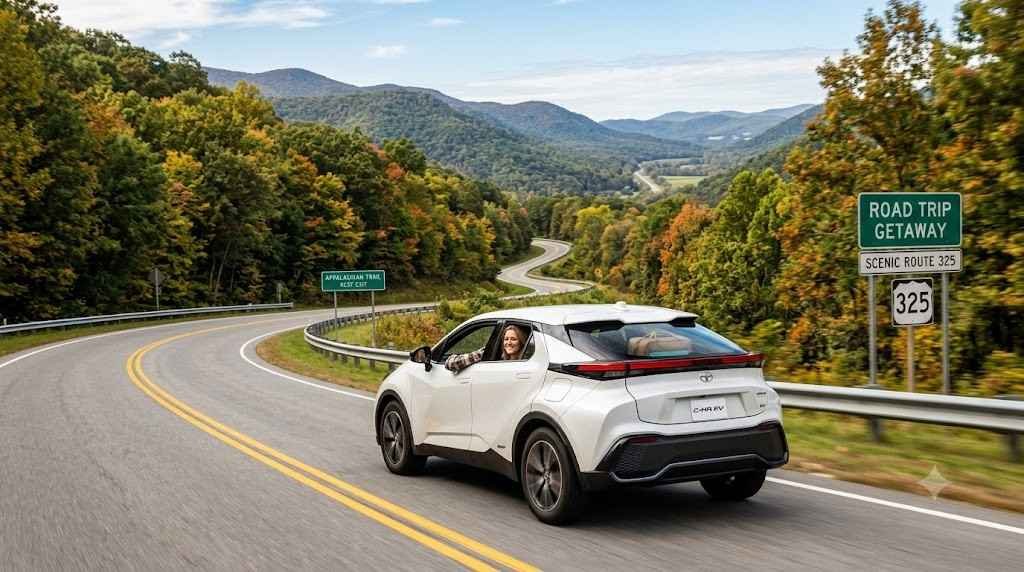
San Diego is a great home base for weekend trips — Julian’s an easy morning drive, Palm Springs and the desert are within striking distance, and LA is close enough for a day trip if traffic cooperates.
If you’re considering to shop the new C-HR at Maverick Toyota, it’s fair to ask whether an EV changes how those trips work. The honest answer: a little, but less than most first-time EV road-trippers expect, as long as you plan the charging stops.
Start With the Real Range Numbers
The 2026 C-HR comes in two trims with different EPA-estimated ranges: up to 287 miles for the SE on 18-inch wheels, and up to 273 miles for the XSE on its larger 20-inch wheels. Those are EPA figures under ideal conditions — in practice, highway driving at sustained higher speeds, running the air conditioning or heater, and cold weather all reduce real-world range somewhat compared to the rated number. For road-trip planning purposes, it’s smart to mentally budget for meaningfully less than the full EPA figure, especially on hot summer freeway runs or cold desert mornings.
Mapping San Diego’s Popular Weekend Routes
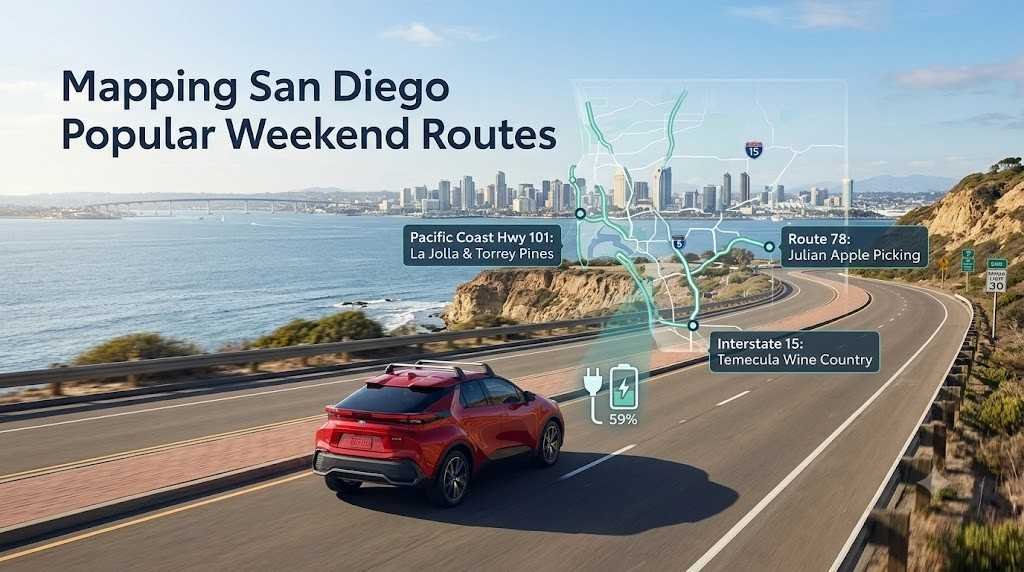
A lot of the region’s classic weekend destinations sit comfortably within a single charge, even accounting for real-world range reduction. Julian is roughly 60 miles from central San Diego — well within range there and back without needing to think about charging at all. Palm Springs is roughly 140 miles out, which a fully charged C-HR should handle on the way there without a stop, though you’d likely want to top off before heading home or find a charger in the desert if you’re stretching the trip further, say toward Joshua Tree. Los Angeles is roughly 120 miles, similarly manageable on a full charge in either direction, especially with San Diego’s dense charging infrastructure at both ends of the drive.
The bigger point isn’t any single number — it’s that most weekend trips from San Diego fall within a C-HR’s range on a full charge, and the ones that don’t usually just need one planned charging stop, not a whole new way of thinking about travel.
Planning Your Charging Stops Like You’d Plan Gas Stops
The C-HR uses a NACS charging port — the same connector Tesla developed, which now gives it access to a wide public charging network including many former Tesla-exclusive Supercharger locations, in addition to networks like Electrify America and EVgo. Toyota rates the C-HR for a 10%-to-80% DC fast charge in around 30 minutes under ideal conditions, which lines up nicely with a rest stop, meal, or gas-station-style break on a longer drive.
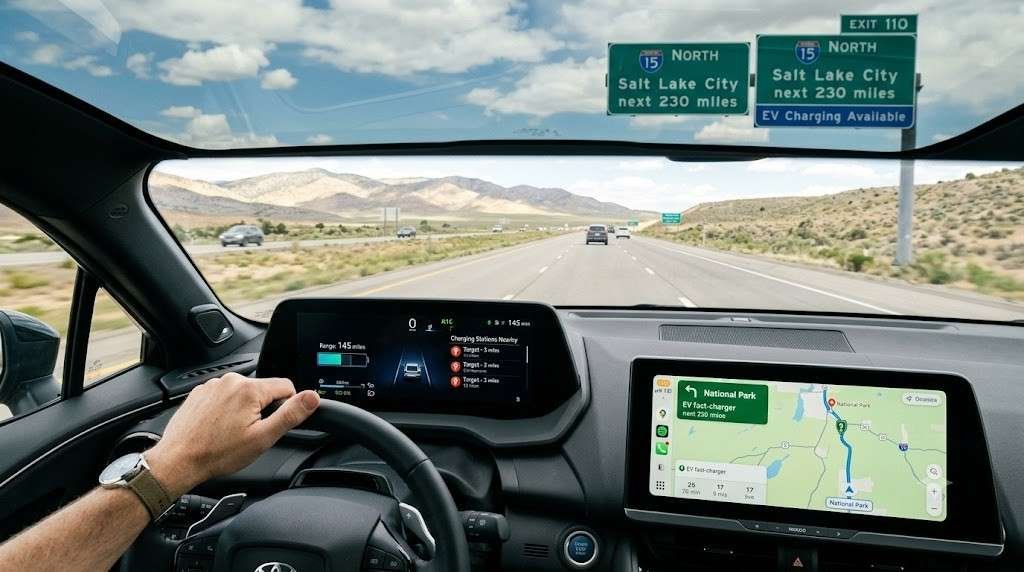
The practical habit that makes EV road trips work is the same one that makes gas road trips work: know your route before you leave. Most in-car navigation systems and third-party route-planning apps will show charging stations along your path and estimate your battery level at each stop, accounting for elevation change and typical speeds — genuinely useful for a route like San Diego to Palm Springs, which climbs through some elevation change along the way. Building in a charging stop before you’re down to a sliver of battery, rather than waiting until you’re anxious about it, makes the whole experience far less stressful. The same planning mindset also applies when learning how to choose right fuel distribution company, where reliability, coverage, and convenience can make a noticeable difference during longer journeys.
What Changes About the Drive Itself
Beyond charging, the C-HR’s regenerative braking is worth getting used to before a long trip rather than during one. Steering-wheel paddle shifters let you adjust regen braking across four levels, which is especially useful on routes with elevation change — heavier regen going downhill can meaningfully extend your range compared to relying purely on friction brakes. It’s a small habit that’s worth practicing on familiar local roads first.
Temperature Matters More Than You’d Think
Desert road trips in particular come with a real tradeoff: hot weather means more air conditioning use, which draws down range faster than driving in mild conditions. If you’re planning a summer trip out toward Palm Springs or Joshua Tree, it’s worth budgeting a bit more conservatively than you would for a cooler-weather trip closer to the coast, and confirming charging station availability at your destination before you go, since desert charging infrastructure can be more spread out than what you’re used to around San Diego.
Packing for the Trip
Range isn’t the only thing that matters for a weekend getaway — you also need somewhere to put your stuff. The C-HR offers up to 25.4 cubic feet of cargo space behind the rear seats, and the 60/40-split rear seats fold flat if you need to bring back a Julian apple pie haul or a couple of mountain bikes with the front wheels off. It’s a genuinely practical amount of space for a compact SUV, and worth knowing before you assume you’ll need something bigger for a weekend trip.
It’s also worth downloading a route-planning app before your first longer drive, even if you plan to rely mostly on the car’s built-in navigation. Apps that specialize in EV routing can factor in real-time charger availability and your specific vehicle’s efficiency, which is a useful second opinion when you’re still building confidence in how the C-HR handles range on unfamiliar roads.
The Honest Take

For the vast majority of weekend trips a San Diego driver would realistically take — Julian, Temecula wine country, LA, even a well-planned run to Palm Springs — the C-HR’s range covers the drive comfortably or requires exactly one thoughtfully placed charging stop. It’s not the vehicle for someone who wants to do a spontaneous, unplanned 400-mile drive with no charging stops at all, but very few gas-powered compact SUVs are ideal for that either without their own fuel stop. If your weekend trips fit a normal pattern, the C-HR handles them well.