
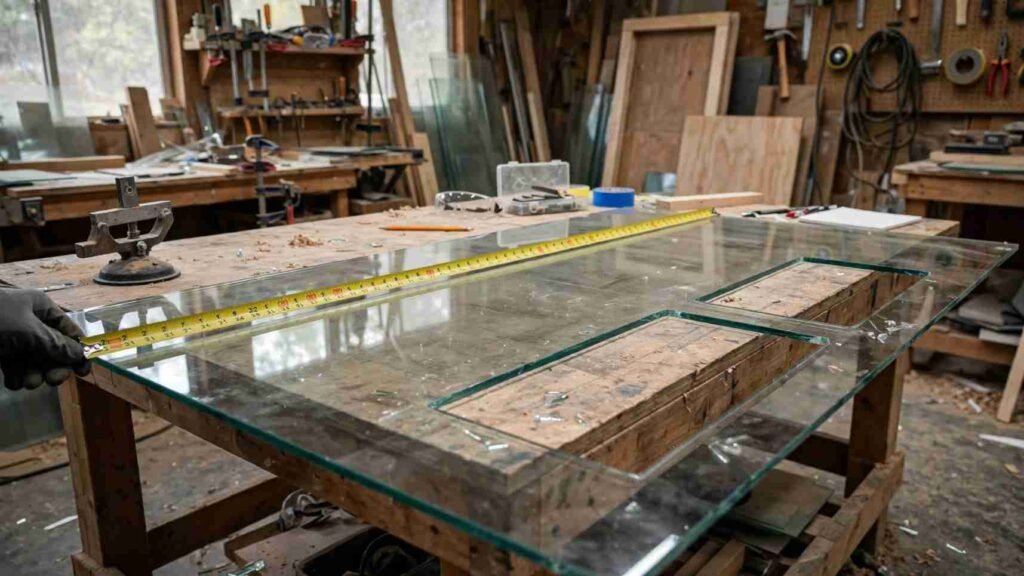
Custom-cut glass needs specifications that match its intended use. A shelf, tabletop, cabinet insert, and protective panel can require different dimensions, edge treatment, thickness, and glass type. The purpose matters before the cutting list is finalized.
Describe where the glass will be installed, how it will be supported, and what contact or loads it may experience. Bring drawings or templates when requested, but ask the fabricator which measurements and details need professional verification. An approximate outline may not be enough for a good fit.
Resolve fabrication details before approval

Ask about corners, holes, notches, edge finish, and any processing needed before delivery. Some glass types and treatments limit later alterations. Tempered glass, for example, cannot simply be trimmed after tempering to correct a sizing error.
When arranging a glass cutting service in Utah, confirm who is responsible for final dimensions and whether installation is included.
Discuss safety requirements for the particular application with the qualified provider. Review the final specification as a complete item rather than approving size alone. Plan transport and handling so the finished piece is protected. A clear order gives the fabricator the information needed to produce glass that fits its function, not just a shape that resembles the initial sketch.
A drawing should identify the reference points used for dimensions. For an irregular piece, ask whether the fabricator needs a physical template and who approves it. Check orientation carefully when holes, notches, or an asymmetric shape are involved. A correct measurement can still produce the wrong result if the drawing is interpreted from the opposite side.
Discuss how the finished piece will be supported and protected during delivery or installation. Ask what tolerances and clearances the provider needs for the application rather than choosing an exact fit by assumption. Resolve questions before fabrication begins. Keeping the approved specification gives both buyer and fabricator a clear reference if the delivered item needs review.
Start with the person using the item

Describe where the item will be used, who will handle it, and what it needs to accomplish. A choice that looks appealing in a product photograph may be uncomfortable, difficult to read, or inconvenient in daily use. Function should guide the design before decorative details are finalized.
When possible, examine a sample or an existing item in a similar setting. Notice size, weight, finish, and ease of cleaning or storage. If several people will use the product, collect feedback from more than one person. Small differences in preferences can become important when an order is large or difficult to change.
Approve details before production
Ask which specifications need final approval and which are only illustrative. A digital preview may not reproduce color, texture, or scale exactly. Confirm dimensions, materials, quantities, and any customization in writing. Check spelling against an authoritative list instead of relying on memory.
For projects that also involve painting nearby surfaces, understanding the benefits of using primer, sealer, and undercoat can help homeowners prepare surrounding materials before installation.
Discuss the production and delivery schedule before choosing a date for distribution or installation. Allow time to review the proof and resolve questions. Ask how errors, damaged items, or missing quantities are handled. Written approval protects the buyer and supplier by giving both parties the same reference for the finished order.
A useful ordering checklist

- Confirm the intended use and required dimensions.
- Review every name, logo, number, and special instruction.
- Ask what the sample or proof accurately represents.
- Check quantities, delivery arrangements, and total cost.
- Keep the approved specifications with the order confirmation.
Consider what happens after delivery
Think about storage, cleaning, replacement, and future reorders while the specifications are still easy to change. A product that requires unusual care may not suit a busy workplace or a one-time event. If continuity matters, ask whether the supplier can retain the approved design and what may vary between orders.
When planning the finished space around custom glass features, homeowners can also explore ideas for enhancing a home with carpet in the Sunshine Coast to coordinate flooring choices with the room’s overall design.
When the order arrives, inspect a representative selection before distributing everything. Compare the delivered items with the approved proof and record any issues promptly. For products used by a group, give people simple handling or care instructions. Good ordering decisions make the item easier to use and reduce the work required to manage it afterward.
For a repeat purchase, note what worked and what caused problems with the previous version. Specific feedback such as difficult fastening, unclear lettering, or awkward storage gives the supplier something concrete to address. Keep one approved sample when consistency matters. It can be useful during future reorders, especially if the person placing the next order was not involved originally. A clear record is often more dependable than trying to match an item from a photograph months later.
Contact Sawyer Glass with your project’s intended use and request guidance on the specifications needed before custom fabrication.