

Families often have practical questions when a teen enters residential care: when can we call, what should we discuss, and who will explain how treatment is going? Agreeing on a communication plan with the care team helps parents and teens know what to expect.
That is where structure matters. A thoughtful communication plan can reduce conflict, protect progress, and help everyone avoid the cycle of reacting to emotion instead of responding to change. For families considering a residential support program for teenage boys, the real question is not whether contact should happen. It is how contact should be organized so it supports growth rather than pulling the family back into old patterns.
Why Family Communication Needs a Plan, Not Just Good Intentions

Many parents assume that if everyone cares enough, communication will naturally improve. That rarely happens on its own. Stress, guilt, fear, and unresolved conflict can all show up quickly in calls or visits. A teen may be defensive. Parents may overcorrect, overexplain, or push too hard for reassurance. The result is often more tension, not less.
A communication plan gives the family a shared structure. It clarifies what topics are helpful, what timing works best, and how to handle difficult emotions without derailing the conversation. It also reduces the pressure on every interaction to “solve everything.” In residential care, that matters because treatment is usually about steady progress, not one dramatic breakthrough.
Live Strong House approaches this reality with the understanding that family relationships remain part of the treatment process. That is a healthier frame than treating residential placement as a pause button on home life. Families still need a way to stay engaged, and they need a way to do it that supports both accountability and trust.
The Hidden Cost of Unstructured Contact
Unplanned communication can create more uncertainty than comfort. A parent may call at the wrong time, ask about a painful topic too early, or interpret a brief response as rejection. A teen may avoid the conversation entirely if he expects criticism, even if the parent’s intention is care.
Structured contact solves that by setting expectations in advance. Families know when they will connect, what the purpose of the conversation is, and how staff will support the process when needed. That kind of predictability lowers emotional noise and makes room for more honest dialogue.
What Strong Family Communication Actually Looks Like
Effective communication in residential care is not about constant contact. It is about contact with a purpose. The best families do not treat every call or visit as an emotional test. They treat it as part of a larger treatment and transition plan.
At Live Strong House, that means families can stay engaged through regular family therapy via secure video calls, updates on broader goals, and guided preparation for visits. The focus is not on creating artificial harmony. It is on building a workable pattern that can hold under stress.
Keep the Conversation Narrow and Useful
hen family communication is under strain, it helps to limit the number of issues discussed in one sitting. Just as mastering year 11 biology works best one module at a time rather than cramming an entire textbook overnight, a single conversation should not become a full review of the past year. Strong families learn to separate immediate concerns from deeper relational work.
Useful conversations often include:
- What went well since the last check-in
- What goal the teen is working on next
- What parents should reinforce during the next visit or call
- What topics are better addressed in family therapy rather than a casual conversation
- What practical support the teen needs before the next transition step
This kind of focus keeps communication from becoming overwhelming. It also helps the teen experience parents as consistent and steady, rather than unpredictable or emotionally overloaded.
How Live Strong House Uses Structure to Support the Whole Family
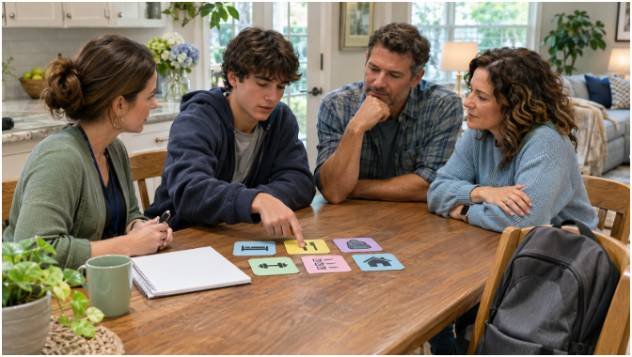
A strong residential model does more than supervise a teen. It creates a daily environment where communication skills are practiced in ordinary life, not just talked about in session. That is one reason Live Strong House is built around a home-style setting with therapists, educators, and live-in life coaches working together.
This matters because communication problems rarely live only in family meetings. They show up in ordinary routines: how a teen handles feedback, how he responds to frustration, how he asks for help, and how he recovers after conflict. A residential setting can make those moments visible and workable.
Live Strong House is especially designed for teenage boys ages 15 to 18 in Utah, and that focus gives the team a clear framework for age-appropriate expectations. The environment is meant to be consistent, not permissive, and relational, not reactive.
Why Privacy and Family Involvement Must Coexist
Parents often worry that staying involved means having access to every private detail. That is not how healthy residential care works, and it should not be. Teens still need appropriate confidentiality in individual therapy, just as families need enough information to stay aligned with treatment goals.
The stronger model is balanced. Parents stay informed about broader progress, objectives, and transition planning without turning the teen’s therapy into a shared performance. This approach protects trust while still keeping families meaningfully connected. It also models a healthier boundary system, which is often part of the work families need most.
Preparing for Visits Without Reopening Old Patterns

Visits can be powerful, but they can also be complicated. A visit that is unplanned or emotionally unmanaged can reset a family into old habits within minutes. That is why preparation matters as much as the visit itself.
Families benefit when they think about three questions before arriving:
- What is the purpose of this visit?
- What emotional triggers are likely to show up?
- What does a successful visit look like in practical terms?
If the answer to the first question is “to fix everything,” the visit is probably carrying too much pressure. A better purpose might be to reinforce progress, practice a respectful conversation, or prepare for the next transition step.
Debriefing After the Visit
The conversation after the visit is just as important as the visit itself. A debrief helps families process what happened without making instant judgments. Did the teen stay regulated? Did parents stay within the agreed boundaries? Did anyone notice a pattern worth bringing to family therapy?
This is where Live Strong House’s structured communication framework becomes especially valuable. Families do not have to guess how to evaluate a visit. They can review it through a clinical lens, which makes the next interaction more intentional than the last one.
The Long View: Communication Is Part of Transition Planning
A common mistake is to think family communication is mainly about the present moment. In reality, it is also about what happens after residential care. If a family waits until discharge to figure out how to talk, the transition becomes much harder than it needs to be.
Planning ahead means the family practices the kind of communication they will need at home later. By embracing positive behaviour support, that includes setting clear expectations, handling disappointment without escalation, and using direct language instead of assumptions. It also means identifying where support is still needed and where the teen is ready for more independence.
Live Strong House builds this into treatment planning and transition planning so families are not left improvising at the end. That forward-looking structure is one of the clearest signs of a serious residential program. It recognizes that progress is not only measured by what happens inside the house. It is also measured by whether the family can function differently after the placement ends.
A good family communication plan does not erase conflict. It makes conflict easier to work through without losing the relationship. That is the real value of steady, structured involvement: it gives everyone a better way to move forward.
If your family is trying to make residential care more collaborative and less uncertain, start by looking for a model that treats communication as part of the treatment itself. Live Strong House is built around that principle, and families who understand it are usually better prepared for the work ahead.